Lesson 3 of 6 · 8 min
Look for proof that people already want it
Before you build anything, learn to spot real demand signals: people already paying for similar tools, searching for the problem, complaining about it online, or hacking together workarounds.
Beginners often ask: will anyone want my idea? You do not have to guess. Demand leaves footprints. People pay for similar tools, search for answers, complain in public, and build clumsy workarounds. This lesson shows you four signals to look for, and how real founders used them before writing code.
A demand signal is evidence that strangers already care about a problem. Not your friends saying "nice idea". Real behaviour: money spent, searches typed, complaints posted, hours wasted on workarounds. Gil Hildebrand, who built Subscribr, puts it bluntly: asking friends what they would pay gives false confidence. Collect money and behaviour, not opinions.
“Too often we just get excited about that invention without making sure that it's actually like a painkiller.”
- 01People payingCompetitors exist and have paying customers
- 02People searchingKeywords and trends show steady interest
- 03People complainingReddit, Twitter, reviews full of frustration
- 04People hacking workaroundsUsing the wrong tool or manual labour to cope
Signal one: people already paying for something similar. This feels backwards to beginners. We think a good idea must be unique. Dmytro Krasun, who built ScreenshotOne, says the opposite: almost nothing is unique, and competitors with customers prove a paying market exists. Deven Bhooshan did the same with Supergrow. He studied three existing LinkedIn tools, then built a small improvement on their core flows.
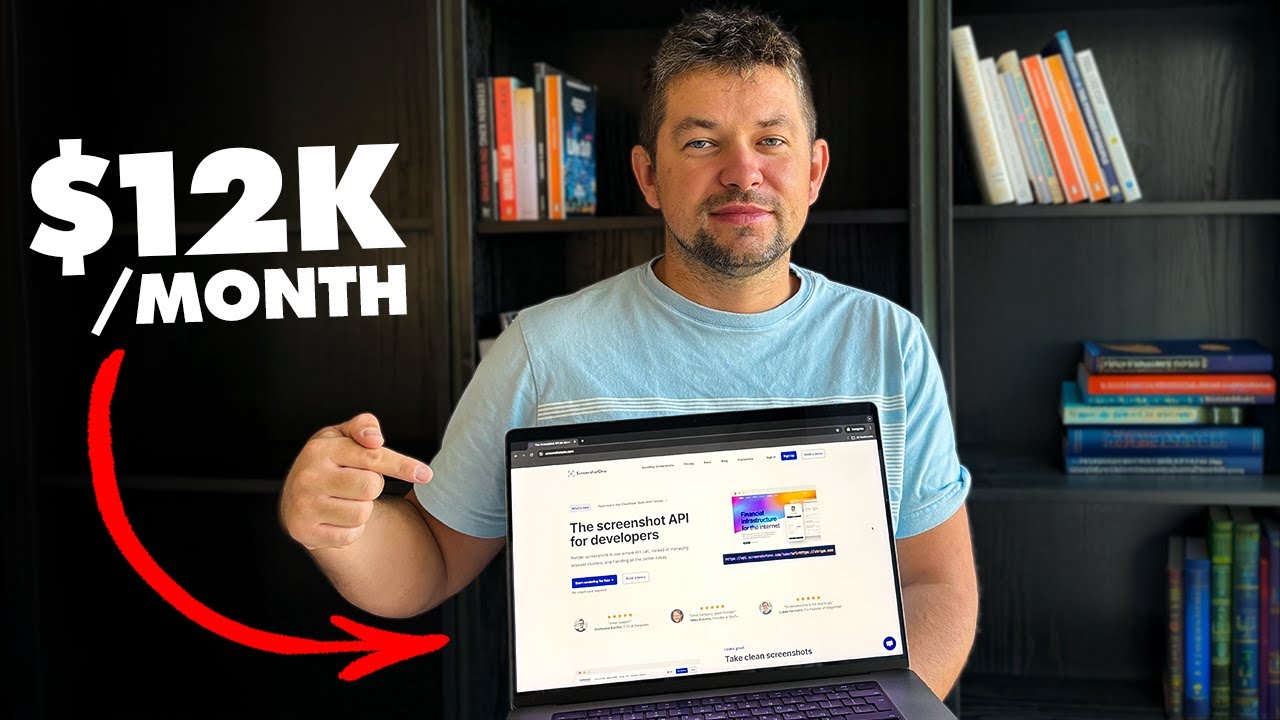
Case study
Dmytro treated competitors as proof, not as a threat
What they did first
- Listed existing screenshot API tools before building his own
- Checked whether enough companies would pay for this kind of software
- Only then committed to building his first version
Take this with you
If others already make money solving your problem, the market is real. Your job is to serve a slice of it better, not to invent a new world.
Signal two: people searching. If nobody types the problem into Google, that is a warning. Steph France uses Google Trends and keyword tools to check that a niche has stable or growing interest before going further. Dmytro uses Google Keyword Planner to predict search volumes before writing content. Vikash found that people search Google for Photoshop help and land on his YouTube videos, which bring him customers for months.
$12K/mo
Reported monthly revenue
$19K/mo
Reported monthly revenue
$10K/mo
Reported monthly revenue
7 days
Days to first version
Signal three: people complaining. Complaints are free market research. Abhishek, who built YouForm, calls his method "finding the gap": take a product that already works, search Twitter, Reddit and the competitor's own forum for complaints, and note the pain points nobody has fixed. Kyan found his idea the same way. He struggled to get guitar tones from ChatGPT, then talked to guitarists on Reddit and Instagram and found many had the exact same problem with no real solution.
“I talked to other guitarists on Reddit, on Instagram, mainly in comment sections, and many of them had the exact same problem, but there was no real solution out there.”
Signal four: people using workarounds. When someone hires a virtual assistant for a repetitive task, or misuses a tool to get a job done, that is demand wearing a disguise. Vikash saw clients on Upwork hiring assistants to make mock-ups one by one. He automated it, finished 1,800 mock-ups in about 30 minutes, and the client paid him $300 without hesitation. Abhishek noticed users of his chatbot were actually using it as a Typeform substitute. That misuse told him exactly what to build next.
Weak proof
- Friends say they would pay
- You personally think it is clever
- Nobody sells anything like it
- Likes on a post about the idea
Strong proof
- Strangers already pay competitors
- Steady search volume for the problem
- Public complaints with no good fix
- People pay for manual workarounds
Your demand-check routine
Step 1: List three competitors
30 minutesSearch for products that solve your problem. If you find none, be careful. Existing competitors with customers mean a paying market exists.
Step 2: Check search interest
30 minutesUse Google Trends and a keyword tool. Look for stable or growing searches about the problem, not a one-week spike.
Step 3: Read 20 complaints
1 hourSearch the product name plus "alternative" on Twitter and Reddit. Read one-star reviews. Copy the exact words people use about their pain.
Step 4: Spot workarounds
30 minutesLook for people hiring humans, misusing other tools, or following long manual steps to solve the problem.
Step 5: Decide with evidence
15 minutesIf you found at least two strong signals, the idea deserves a small test. If you found none, park it and check the next idea.
Your turn
30 minRun the four-signal check on one idea
Pick one idea from your list. Open a blank page and make four boxes: paying, searching, complaining, workarounds. Spend 20 minutes filling each box with real evidence you find online: competitor names, a Google Trends screenshot, three complaint quotes, one workaround example. No opinions allowed, only things strangers did or said.
What you'll have at the end
One page with evidence in at least two of the four boxes, plus a one-line verdict: test it or park it.
Key takeaways
- Demand leaves footprints: payments, searches, complaints and workarounds.
- Competitors with customers are proof of a market, not a reason to quit.
- Search product names plus "alternative" to find unhappy users fast.
- People paying humans for repetitive work are showing you a product idea.
- Collect evidence from strangers, never opinions from friends.
Where this comes from

How I Built It: $30K/month Micro-SaaS (Subscribr Breakdown)
Gil Hildebrand · Subscribr
Watch on SuperBuilderHow Dmytro Krasun scaled a screenshot micro saas to $12K a month
Dmytro Krasun · ScreenshotOne
Watch on SuperBuilder
How I Made $65,000 in 3 Days with Lifetime Deals: The SaaS Growth Playbook
Deven Bhooshan · Supergrow
Watch on SuperBuilder
How to use AI to find a million-dollar business idea and build a landing page
Steph France
Watch on SuperBuilder

I Copied a $100M SaaS, Undercut Their Prices, and Hit $10K/Month
Abhishek · YouForm
Watch on SuperBuilder
Builder Copilot
Knows this lesson · Look for proof that people already want it
Hi! I've read the whole Look for proof that people already want it lesson.
Ask how it applies to you: your budget, skills, city or idea. I'll point you to the parts of the lesson that matter.
Try asking
Your chats are saved, so Copilot remembers what you tell it.